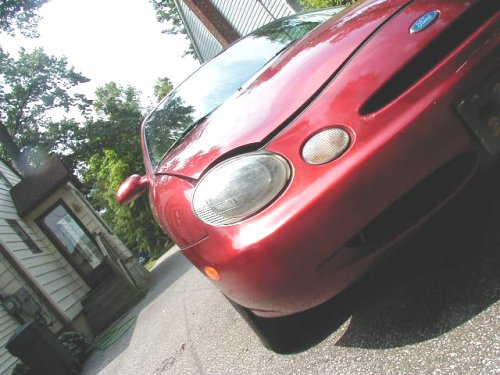
The 1996 model year brought the third-generation Ford Taurus, a full redesign built around an oval styling theme that extended from the grille and rear window to interior details. The engine lineup changed: the pushrod Vulcan 3.0 V6, rated at 145 horsepower, continued as the base engine, while a new dual-overhead-cam Duratec 3.0 V6, rated at 200 horsepower, was offered on the upper LX trim, both with a four-speed automatic. The performance Taurus SHO switched from the Yamaha V6 of earlier years to a 3.4 Yamaha V8, a 60-degree dual-overhead-cam 32-valve engine rated at 235 horsepower and 230 lb-ft of torque, paired only with the four-speed AX4N automatic. This was the only V8-powered Taurus SHO, and it ran for four model years, 1996 through 1999. The oval theme was not well received, and the Taurus lost its position as the best-selling car in the United States to the Toyota Camry for the 1997 model year after holding it from 1992 through 1996. The 3.4 SHO V8 later became known for a camshaft-sprocket failure traced to how Yamaha attached the sprockets to the camshafts. The Mercury Sable continued as the badge-engineered sibling.
The 1996-1999 Ford Taurus at a glance
- Generation: third-generation Ford Taurus, the oval-themed full redesign
- Years: 1996 through 1999, replaced by the fourth-generation Taurus for 2000
- Engines: pushrod Vulcan 3.0 V6 (145 hp); Duratec 3.0 DOHC V6 (200 hp); SHO Yamaha 3.4 V8 (235 hp)
- Transmissions: four-speed automatic on standard models; four-speed AX4N automatic on the SHO V8
- Body styles: four-door sedan and four-door wagon
- Sales: best-selling car in the United States for 1996, then lost the title to the Toyota Camry for 1997
- Performance variant: Taurus SHO with the 3.4 Yamaha V8, the only V8 Taurus, built 1996-1999
- Known issue: the 3.4 SHO V8 camshaft-sprocket failure
Ford Taurus 1996-1999 year by year
| Year | Ford Taurus changes | Engines offered |
|---|---|---|
| 1996 | Third-generation Ford Taurus arrives with the oval styling theme; the Duratec 3.0 DOHC V6 joins the lineup and the SHO switches to a 3.4 Yamaha V8 | Vulcan 3.0 V6; Duratec 3.0 V6; SHO 3.4 V8 |
| 1997 | The Ford Taurus loses its best-selling-car title in the United States to the Toyota Camry; the oval-theme lineup continues | Vulcan 3.0 V6; Duratec 3.0 V6; SHO 3.4 V8 |
| 1998 | The 1998 Ford Taurus continues the third-generation sedan, wagon, and SHO lineup | Vulcan 3.0 V6; Duratec 3.0 V6; SHO 3.4 V8 |
| 1999 | Final model year of the third-generation Ford Taurus and the last year of the V8 SHO | Vulcan 3.0 V6; Duratec 3.0 V6; SHO 3.4 V8 |
The oval redesign
The 1996 Ford Taurus was a full redesign that applied an oval styling theme across the car, including an oval grille, oval rear window, and oval interior elements. The redesign was more divisive than the first two generations, and the styling is commonly cited as a reason the Taurus lost momentum against rivals such as the Toyota Camry. The third-generation Taurus was offered as a four-door sedan and a four-door wagon, with the Mercury Sable as the badge-engineered counterpart. The Taurus remained the best-selling car in the United States for the 1996 model year, then ceded the title to the Camry for 1997.
Engines and transmissions of the 1996-1999 Ford Taurus
The base engine of the 1996-1999 Ford Taurus was the pushrod Vulcan 3.0 V6, a two-valve-per-cylinder engine rated at 145 horsepower at 5250 rpm and 170 lb-ft of torque. The upper engine was the new dual-overhead-cam Duratec 3.0 V6, a four-valve-per-cylinder engine rated at 200 horsepower at 5750 rpm and 200 lb-ft of torque, offered on the LX. Both standard engines used a four-speed automatic. The Duratec 3.0 marked the Taurus's move to a modern dual-overhead-cam V6 alongside the older pushrod engine.
Trim levels and body styles
The 1996-1999 Ford Taurus was offered in trims that included the G and GL with the Vulcan 3.0 V6, the LX with the Duratec 3.0 V6, and the performance SHO with the 3.4 V8. Both the four-door sedan and the four-door wagon were available, while the SHO was a sedan. The Mercury Sable provided a parallel lineup under a separate badge.
The V8 Taurus SHO (1996-1999)
The third-generation Taurus SHO replaced the earlier Yamaha V6 with a 3.4 Yamaha V8, a 60-degree dual-overhead-cam 32-valve engine based on the Duratec family rather than the older SHO V6. It used an aluminum block and a structural aluminum oil pan, making it lighter than the iron-block V6, and was rated at 235 horsepower and 230 lb-ft of torque. The only transmission was the four-speed AX4N automatic, so unlike the earlier V6 SHO the V8 SHO was never offered with a manual. The engines were assembled by Yamaha in Japan. This was the only V8-powered Taurus SHO, built across the 1996 through 1999 model years; about 19,730 V8 SHOs were produced. The 3.4 V8 became known for a camshaft-sprocket failure, in which a sprocket could break loose from its camshaft because of the swaging method Yamaha used to attach it; many owners had the sprockets welded or pinned as a preventive measure.
Frequently asked questions
What generation is the 1996-1999 Ford Taurus?
The 1996-1999 Ford Taurus is the third generation, the oval-themed full redesign. It introduced the Duratec 3.0 dual-overhead-cam V6 and switched the SHO to a 3.4 Yamaha V8, and it is the generation in which the Taurus lost the U.S. sales crown to the Toyota Camry.
What engines did the 1996-1999 Ford Taurus use?
The 1996-1999 Ford Taurus used the pushrod Vulcan 3.0 V6 rated at 145 horsepower as the base engine and the new dual-overhead-cam Duratec 3.0 V6 rated at 200 horsepower on the LX. The performance SHO used a 3.4 Yamaha V8 rated at 235 horsepower.
What is the difference between the Vulcan and Duratec V6?
In the 1996-1999 Ford Taurus, the Vulcan 3.0 is a pushrod (overhead-valve) two-valve V6 rated at 145 horsepower, while the Duratec 3.0 is a dual-overhead-cam four-valve V6 rated at 200 horsepower. The Duratec was the upper engine on the LX.
Did the V8 Taurus SHO have a manual transmission?
No. The 1996-1999 Ford Taurus SHO used the 3.4 Yamaha V8 paired only with the four-speed AX4N automatic. The manual transmission was unique to the earlier Yamaha V6 SHO of 1989 through 1995.
What is the 3.4 SHO V8 camshaft-sprocket problem?
The 3.4 Yamaha V8 in the 1996-1999 Taurus SHO could suffer a camshaft-sprocket failure, in which a sprocket broke loose from its camshaft because of the swaging method used to attach it. When that happened the camshaft stopped turning the valves, which could damage the engine, so many owners welded or pinned the sprockets as a preventive fix.
Sources
- Wikipedia, Ford Taurus (third generation)
- Wikipedia, Ford SHO V8 engine
- Ford-Taurus.org Taurus/Sable Encyclopedia, third-generation history
- V8SHO.com camshaft-sprocket failure documentation
- Manufacturer specification figures and contemporary sales reporting
Asked all the time
What generation is the 1996-1999 Ford Taurus?
The 1996-1999 Ford Taurus is the third generation, the oval-themed full redesign. It introduced the Duratec 3.0 dual-overhead-cam V6 and switched the SHO to a 3.4 Yamaha V8, and it is the generation in which the Taurus lost the U.S. sales crown to the Toyota Camry.
What engines did the 1996-1999 Ford Taurus use?
The 1996-1999 Ford Taurus used the pushrod Vulcan 3.0 V6 rated at 145 horsepower as the base engine and the new dual-overhead-cam Duratec 3.0 V6 rated at 200 horsepower on the LX. The performance SHO used a 3.4 Yamaha V8 rated at 235 horsepower.
What is the difference between the Vulcan and Duratec V6?
In the 1996-1999 Ford Taurus, the Vulcan 3.0 is a pushrod (overhead-valve) two-valve V6 rated at 145 horsepower, while the Duratec 3.0 is a dual-overhead-cam four-valve V6 rated at 200 horsepower. The Duratec was the upper engine on the LX.
Did the V8 Taurus SHO have a manual transmission?
No. The 1996-1999 Ford Taurus SHO used the 3.4 Yamaha V8 paired only with the four-speed AX4N automatic. The manual transmission was unique to the earlier Yamaha V6 SHO of 1989 through 1995.
What is the 3.4 SHO V8 camshaft-sprocket problem?
The 3.4 Yamaha V8 in the 1996-1999 Taurus SHO could suffer a camshaft-sprocket failure, in which a sprocket broke loose from its camshaft because of the swaging method used to attach it. When that happened the camshaft stopped turning the valves, which could damage the engine, so many owners welded or pinned the sprockets as a preventive fix.
The wall · registered 1996–1999 Tauruss
Sorted by depth of documentation. Click any vehicle to open its permanent record.