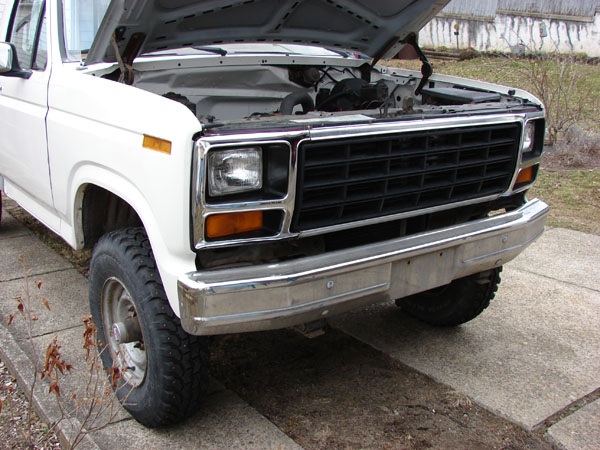
The 1980 model year brought the seventh-generation Ford F-Series, nicknamed the "Bullnose," the first complete redesign of the truck since 1965. The 1980-1986 Ford F-250 is the three-quarter-ton version, sharing its all-new cab and sheet metal with the rest of the F-Series. Two engineering changes define this generation for the F-250. First, the four-wheel-drive F-250 moved from a solid front axle to Twin-Traction Beam (TTB) independent front suspension, using a Dana 44HD on lighter trucks and a Dana 50 on the heavy-duty F-250 rated over 8,500 pounds. Second, the 6.9L IDI (indirect injection) diesel V8, built by International Harvester, arrived for the 1983 model year as the first diesel ever offered in the F-250. The gas engines included the 300-cubic-inch (4.9L) inline-six as the base engine and the 302 (5.0L) small-block, with the carryover 351M and 400 (335-series) big-blocks offered for 1980-1981 before the 351 Windsor (5.8L) replaced the 351M for 1982 and the 400 was discontinued. The 460 (7.5L) big-block left the lineup for 1980 and returned for 1983. Electronic fuel injection arrived on the 300 and 302 for 1985. The 1980-1986 Ford F-250 was offered in regular-cab, SuperCab, and Crew Cab forms, with the Camper Special package available.
The 1980-1986 Ford F-250 at a glance
- Generation: seventh-generation F-Series, nicknamed the "Bullnose," the first full redesign since 1965
- Years: 1980 through 1986, replaced by the eighth-generation OBS F-250 for 1987
- Front suspension change: the 4x4 F-250 moved to Twin-Traction Beam independent front (Dana 44HD on lighter trucks, Dana 50 on the F-250 HD)
- First diesel: the 6.9L IDI V8, built by International Harvester, arrived for 1983
- Gas engines: 300 (4.9L) I6; 302 (5.0L); 351M and 400 (1980-81); 351 Windsor (5.8L, from 1982); 460 (7.5L, returned for 1983)
- Fuel injection: EFI arrived on the 300 and 302 for 1985
- Transmissions: three-speed and four-speed manuals (NP435, T-19); C6 three-speed automatic on heavy-duty trucks
- Body styles: regular cab, SuperCab, and Crew Cab; Camper Special offered
Ford F-250 1980-1986 year by year
| Year | Ford F-250 changes | Engines offered |
|---|---|---|
| 1980 | Seventh-generation "Bullnose" redesign arrives; the 4x4 F-250 switches to Twin-Traction Beam independent front suspension; the 460 is dropped | 300 I6; 302; 351M; 400 |
| 1981 | Minor changes to the Ford F-250; powertrain carries over | 300 I6; 302; 351M; 400 |
| 1982 | Grille restyle with the blue oval moved to the grille center; the 351 Windsor replaces the 351M and the 400 is discontinued | 300 I6; 302; 351W |
| 1983 | The 6.9L IDI diesel V8 is introduced as the first diesel in the Ford F-250; the 460 (7.5L) big-block returns | 300 I6; 302; 351W; 460; 6.9L IDI diesel |
| 1984 | The F-100 is discontinued, leaving the F-150 as the smallest F-Series below the F-250; a 351 HO V8 is added | 300 I6; 302; 351W; 460; 6.9L IDI diesel |
| 1985 | Electronic fuel injection arrives on the 300 inline-six and the 302 V8 in the Ford F-250 | 300 I6 (EFI); 302 (EFI); 351W; 460; 6.9L IDI diesel |
| 1986 | Final year of the Bullnose Ford F-250; last year for the column-shift three-speed manual | 300 I6 (EFI); 302 (EFI); 351W; 460; 6.9L IDI diesel |
What the "Bullnose" label means
The 1980 Ford F-250 introduced the seventh-generation F-Series, the first complete redesign of the truck since 1965. Enthusiasts nickname it the "Bullnose" for the rounded, aerodynamic-leaning front end, a shape adopted to improve fuel economy after the 1970s fuel crises. The redesign brought an all-new chassis and body, retired the previous clamshell hood, and widened the Styleside bed. As before, the 1980-1986 F-250 shared its cab and sheet metal with the rest of the F-Series, with the three-quarter-ton truck distinguished by its heavier chassis and higher ratings. With the F-100 discontinued after 1983, the F-150 became the smallest F-Series from 1984, sitting directly below the F-250.
The Twin-Traction Beam front suspension
The most significant chassis change for the 1980-1986 Ford F-250 was the move from a solid front axle to Twin-Traction Beam (TTB) independent front suspension on the four-wheel-drive trucks. TTB uses two long beams that pivot independently, each carrying one front wheel, so each side can move on its own rather than being tied together by a solid axle. The lighter-duty four-wheel-drive F-250, rated under 8,500 pounds gross weight, used a Dana 44HD TTB, while the heavy-duty F-250 rated over 8,500 pounds used a Dana 50 TTB. Both are independent designs. This is a point of common confusion: the 1980-1986 F-250, including the heavy-duty version, did not use a solid front axle. The solid front axle in this era belonged to the one-ton F-350, which switched to a solid Dana 60 around the 1985 model year, and the solid front axle would not return to the F-250 until the Super Duty platform arrived for 1999.
The arrival of the 6.9L IDI diesel
The 1983 model year brought the first diesel ever offered in the Ford F-250: the 6.9L IDI (indirect injection) V8, built by International Harvester. It was a naturally aspirated diesel rated at roughly 150 to 170 horsepower with strong low-speed torque, aimed at buyers who wanted diesel economy and durability for towing and hauling in a three-quarter-ton truck. The 6.9L IDI began the long F-250 diesel line that would run through the 7.3L IDI, the 7.3L Power Stroke, and the later 6.0L, 6.4L, and 6.7L Power Stroke engines. The gas engines remained the core of the lineup: the 300 inline-six base engine, the 302 and 351 Windsor V8s, and the 460 (7.5L) big-block, which had been dropped for 1980 and returned for 1983.
Engines, fuel injection, and transmissions
The gas engine lineup of the 1980-1986 Ford F-250 began with the 300-cubic-inch (4.9L) inline-six and the 302 (5.0L) small-block, with the 351 Windsor (5.8L) replacing the older 351M for 1982 when the 400 was also discontinued. The 460 (7.5L) big-block returned for 1983 for heavy towing. Electronic fuel injection arrived on the 300 and 302 for the 1985 model year, replacing their carburetors. Transmissions included three-speed and four-speed manuals, among them the NP435 and the heavier-duty T-19 often paired with the diesel, and the C6 three-speed automatic, which served as the heavy-duty automatic for the diesel and big-block F-250. The 1986 model year was the last to offer the column-shift three-speed manual.
Frequently asked questions
What generation is the 1980-1986 Ford F-250?
The 1980-1986 Ford F-250 is the seventh-generation F-Series, nicknamed the "Bullnose," the first complete redesign of the truck since 1965. It is the three-quarter-ton truck of the generation and was replaced by the eighth-generation OBS F-250 for 1987.
Did the 1980-1986 Ford F-250 4x4 have a solid front axle?
No. The 1980-1986 Ford F-250 4x4 used Twin-Traction Beam independent front suspension, a Dana 44HD on lighter trucks and a Dana 50 on the heavy-duty F-250 rated over 8,500 pounds. This applied even to the heavy-duty F-250; the solid front axle in this era belonged to the one-ton F-350, and the solid axle did not return to the F-250 until the Super Duty arrived for 1999.
When did the Ford F-250 get a diesel engine?
The Ford F-250 got its first diesel for the 1983 model year, the 6.9L IDI (indirect injection) V8 built by International Harvester. It was a naturally aspirated diesel rated at roughly 150 to 170 horsepower and began the F-250 diesel line that later included the 7.3L IDI and the 7.3L Power Stroke.
What gas engines did the 1980-1986 Ford F-250 use?
The 1980-1986 Ford F-250 used the 300 (4.9L) inline-six as the base engine, the 302 (5.0L) V8, and the 351 Windsor (5.8L) V8, plus the 460 (7.5L) big-block, which was dropped for 1980 and returned for 1983. Electronic fuel injection arrived on the 300 and 302 for 1985.
When did the Ford F-100 disappear from below the F-250?
The Ford F-100 was discontinued after the 1983 model year, leaving the F-150 as the smallest F-Series from 1984 and sitting directly below the three-quarter-ton F-250.
Sources
- Ford factory specification sheets for the 1980-1986 F-Series
- Wikipedia, Ford F-Series (seventh generation)
- Blue Oval Trucks and The Ranger Station references on Dana 44HD and Dana 50 Twin-Traction Beam front axles
- DieselHub reference, 6.9L IDI diesel
- VIN and data-plate decoding for engine and axle identification
Asked all the time
What generation is the 1980-1986 Ford F-250?
The 1980-1986 Ford F-250 is the seventh-generation F-Series, nicknamed the "Bullnose," the first complete redesign of the truck since 1965. It is the three-quarter-ton truck of the generation and was replaced by the eighth-generation OBS F-250 for 1987.
Did the 1980-1986 Ford F-250 4x4 have a solid front axle?
No. The 1980-1986 Ford F-250 4x4 used Twin-Traction Beam independent front suspension, a Dana 44HD on lighter trucks and a Dana 50 on the heavy-duty F-250 rated over 8,500 pounds. This applied even to the heavy-duty F-250; the solid front axle in this era belonged to the one-ton F-350, and the solid axle did not return to the F-250 until the Super Duty arrived for 1999.
When did the Ford F-250 get a diesel engine?
The Ford F-250 got its first diesel for the 1983 model year, the 6.9L IDI (indirect injection) V8 built by International Harvester. It was a naturally aspirated diesel rated at roughly 150 to 170 horsepower and began the F-250 diesel line that later included the 7.3L IDI and the 7.3L Power Stroke.
What gas engines did the 1980-1986 Ford F-250 use?
The 1980-1986 Ford F-250 used the 300 (4.9L) inline-six as the base engine, the 302 (5.0L) V8, and the 351 Windsor (5.8L) V8, plus the 460 (7.5L) big-block, which was dropped for 1980 and returned for 1983. Electronic fuel injection arrived on the 300 and 302 for 1985.
When did the Ford F-100 disappear from below the F-250?
The Ford F-100 was discontinued after the 1983 model year, leaving the F-150 as the smallest F-Series from 1984 and sitting directly below the three-quarter-ton F-250.
The wall · registered 1980–1986 F-250s
Sorted by depth of documentation. Click any vehicle to open its permanent record.