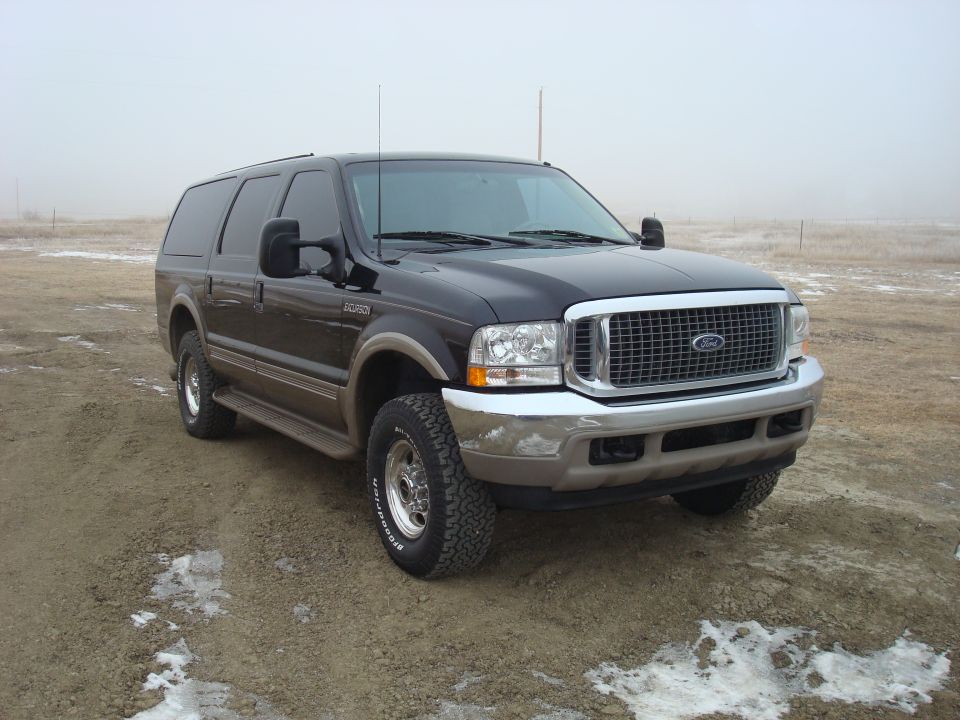
The 2000 model year introduced the Ford Excursion, a full-size SUV built on the Super Duty pickup chassis and sharing its frame, suspension, and engines with the three-quarter-ton F-250 and one-ton F-350 trucks. Ford built the Excursion at Kentucky Truck Assembly in Louisville for the 2000 through 2005 model years as a single generation. The 2000-2005 Ford Excursion measured 226.7 inches long on a 137.1-inch wheelbase, the largest and longest-wheelbase SUV Ford ever produced, with a gasoline curb weight near 7,200 pounds and a diesel curb weight near 7,700 pounds. The Excursion offered the 5.4L Triton V8 (255 horsepower) as the standard gasoline engine and the 6.8L Triton V10 (310 horsepower) as the gasoline upgrade. The diesel option was the 7.3L Power Stroke turbo-diesel V8 (235 horsepower at launch, up to 250 horsepower) from 2000 through 2003, replaced partway through the 2003 model year by the 6.0L Power Stroke turbo-diesel V8 (325 horsepower), which the Excursion used through 2005. Ford fitted a steel under-bumper crash bar called the BlockerBeam to lower the front structure toward passenger-car bumper height. Ford ended Excursion production after 2005 as fuel prices rose and demand for the largest SUVs fell.
The 2000-2005 Ford Excursion at a glance
- Generation: the first and only Ford Excursion, a full-size SUV on the Super Duty F-250/F-350 chassis
- Years: 2000 through 2005, built at Kentucky Truck Assembly in Louisville
- Size: 226.7 inches long on a 137.1-inch wheelbase, the largest SUV Ford ever sold
- Curb weight: about 7,200 lb gasoline, about 7,700 lb diesel
- Gasoline engines: 5.4L Triton V8 (255 hp, 350 lb-ft); 6.8L Triton V10 (310 hp, 425 lb-ft)
- Diesel engines: 7.3L Power Stroke V8 (235 hp at launch, up to 250 hp, 525 lb-ft) 2000-2003; 6.0L Power Stroke V8 (325 hp, 560 lb-ft) mid-2003 to 2005
- Transmissions: 4R100 four-speed automatic; 5R110W TorqShift five-speed automatic with the 6.0L diesel
- Seating: up to nine passengers in three rows, in two-wheel drive and four-wheel drive
Ford Excursion 2000-2005 year by year
| Year | Ford Excursion changes | Engines offered |
|---|---|---|
| 2000 | The Ford Excursion launches on the Super Duty chassis at 226.7 inches long; reverse sensing system offered late in the year | 5.4L V8; 6.8L V10; 7.3L Power Stroke diesel |
| 2001 | The Ford Excursion adds standard fog lights and reverse sensing on Limited; a monochrome appearance package arrives mid-year | 5.4L V8; 6.8L V10; 7.3L Power Stroke diesel |
| 2002 | The Ford Excursion expands trim choices and adopts revised headlamps across the lineup | 5.4L V8; 6.8L V10; 7.3L Power Stroke diesel |
| 2003 | The 6.0L Power Stroke diesel replaces the 7.3L partway through the year, paired with the 5R110W TorqShift; the Eddie Bauer trim is added and the front suspension is revised | 5.4L V8; 6.8L V10; 7.3L Power Stroke diesel (early); 6.0L Power Stroke diesel (from mid-year) |
| 2004 | The Ford Excursion adds a lower XLS trim and moves the XLT to the middle of the range | 5.4L V8; 6.8L V10; 6.0L Power Stroke diesel |
| 2005 | Final model year of the Ford Excursion; Ford ends production with no successor on the Super Duty platform | 5.4L V8; 6.8L V10; 6.0L Power Stroke diesel |
The Ford Excursion and the Super Duty chassis
The 2000-2005 Ford Excursion was built on the Super Duty pickup platform, sharing its ladder frame, axles, and engines, with 4WD Excursions using a solid front axle and 2WD Excursions a Twin-I-Beam independent front suspension with the three-quarter-ton F-250 and one-ton F-350 trucks rather than with the lighter F-150-based Ford Expedition. This is why the Excursion was heavier and more capable of heavy towing than the Expedition sold alongside it. Ford assembled the Excursion at Kentucky Truck Assembly in Louisville, and across all six model years it seated up to nine passengers in three rows and was offered in two-wheel drive and four-wheel drive.
Engines and transmissions of the 2000-2005 Ford Excursion
The standard gasoline engine of the 2000-2005 Ford Excursion was the 5.4L Triton SOHC V8 rated at 255 horsepower and 350 lb-ft of torque. The optional gasoline engine was the 6.8L Triton SOHC V10 rated at 310 horsepower and 425 lb-ft of torque. The diesel option at launch was the 7.3L Power Stroke turbo-diesel V8, a Navistar-built engine rated at 250 horsepower and 525 lb-ft of torque, offered from 2000 through the 2003 model year. Ford replaced the 7.3L partway through 2003 with the 6.0L Power Stroke turbo-diesel V8 rated at 325 horsepower and 560 lb-ft of torque, which the Excursion used through 2005. The gasoline engines and the 7.3L diesel used the 4R100 four-speed automatic, while the 6.0L diesel paired with the 5R110W TorqShift five-speed automatic. Because the diesel changeover happened mid-year, a 2003 Ford Excursion can have either the 7.3L or the 6.0L Power Stroke.
Size, weight, and the BlockerBeam
The 2000-2005 Ford Excursion measured 226.7 inches in overall length on a 137.1-inch wheelbase, the longest wheelbase of any SUV Ford produced. Gasoline versions carried a curb weight near 7,200 pounds and diesel versions near 7,700 pounds, with GVWR ratings around 8,600 to 9,200 pounds depending on engine and drivetrain. Because the Excursion sat high on the Super Duty chassis, Ford fitted a steel under-bumper crash bar called the BlockerBeam to lower the front structure toward the bumper height of a passenger car, addressing concern that the tall front end could override a smaller vehicle in a frontal collision.
Trim levels and the end of production
The Ford Excursion launched with the XLT and Limited trims, then expanded the lineup over its run. For 2003 Ford added the Eddie Bauer trim, and for 2004 Ford added a lower XLS trim while the XLT moved to the middle of the range. The 2005 model year was the final year for the Ford Excursion. Ford ended production as fuel prices rose and demand for the largest, heaviest SUVs declined, and it did not replace the Excursion on the Super Duty platform. The extended-length Expedition EL, introduced for 2007 on lighter F-150 architecture, took over the role of Ford's largest SUV.
Frequently asked questions
What chassis is the 2000-2005 Ford Excursion built on?
The 2000-2005 Ford Excursion is built on the Super Duty pickup chassis, sharing its ladder frame, axles, and engines, with 4WD Excursions using a solid front axle and 2WD Excursions a Twin-I-Beam independent front suspension with the three-quarter-ton F-250 and one-ton F-350 trucks. This makes the Excursion heavier and more tow-capable than the F-150-based Ford Expedition.
What engines did the 2000-2005 Ford Excursion use?
The 2000-2005 Ford Excursion used the 5.4L Triton V8 (255 hp), the 6.8L Triton V10 (310 hp), the 7.3L Power Stroke turbo-diesel V8 (235 hp at launch, up to 250 hp) from 2000 through 2003, and the 6.0L Power Stroke turbo-diesel V8 (325 hp) that replaced the 7.3L partway through the 2003 model year and ran through 2005.
How big is the Ford Excursion?
The Ford Excursion measured 226.7 inches in overall length on a 137.1-inch wheelbase, the largest and longest-wheelbase SUV Ford ever produced. Gasoline versions weighed about 7,200 pounds at the curb and diesel versions about 7,700 pounds.
Did the 2003 Ford Excursion have the 7.3 or the 6.0 Power Stroke?
A 2003 Ford Excursion can have either diesel. Ford replaced the 7.3L Power Stroke with the 6.0L Power Stroke partway through the 2003 model year, so early 2003 Excursions have the 7.3L and later 2003 Excursions have the 6.0L, which then ran through 2005.
Why did Ford stop making the Excursion?
Ford ended Ford Excursion production after the 2005 model year as fuel prices rose and demand for the largest, heaviest SUVs declined. Ford did not replace the Excursion on the Super Duty platform; the extended-length Expedition EL arrived for 2007 on lighter F-150 architecture as Ford's largest SUV.
Sources
- Ford factory specification sheets and brochures for the 2000-2005 Excursion
- Wikipedia, Ford Excursion
- Navistar and Ford Power Stroke diesel production records (7.3L and 6.0L)
- Ford Super Duty chassis and powertrain references for the 2000-2005 period
Asked all the time
What chassis is the 2000-2005 Ford Excursion built on?
The 2000-2005 Ford Excursion is built on the Super Duty pickup chassis, sharing its ladder frame, axles, and engines, with 4WD Excursions using a solid front axle and 2WD Excursions a Twin-I-Beam independent front suspension with the three-quarter-ton F-250 and one-ton F-350 trucks. This makes the Excursion heavier and more tow-capable than the F-150-based Ford Expedition.
What engines did the 2000-2005 Ford Excursion use?
The 2000-2005 Ford Excursion used the 5.4L Triton V8 (255 hp), the 6.8L Triton V10 (310 hp), the 7.3L Power Stroke turbo-diesel V8 (235 hp at launch, up to 250 hp) from 2000 through 2003, and the 6.0L Power Stroke turbo-diesel V8 (325 hp) that replaced the 7.3L partway through the 2003 model year and ran through 2005.
How big is the Ford Excursion?
The Ford Excursion measured 226.7 inches in overall length on a 137.1-inch wheelbase, the largest and longest-wheelbase SUV Ford ever produced. Gasoline versions weighed about 7,200 pounds at the curb and diesel versions about 7,700 pounds.
Did the 2003 Ford Excursion have the 7.3 or the 6.0 Power Stroke?
A 2003 Ford Excursion can have either diesel. Ford replaced the 7.3L Power Stroke with the 6.0L Power Stroke partway through the 2003 model year, so early 2003 Excursions have the 7.3L and later 2003 Excursions have the 6.0L, which then ran through 2005.
Why did Ford stop making the Excursion?
Ford ended Ford Excursion production after the 2005 model year as fuel prices rose and demand for the largest, heaviest SUVs declined. Ford did not replace the Excursion on the Super Duty platform; the extended-length Expedition EL arrived for 2007 on lighter F-150 architecture as Ford's largest SUV.
The wall · registered 2000–2005 Excursions
Sorted by depth of documentation. Click any vehicle to open its permanent record.